> For the complete documentation index, see [llms.txt](https://docs.stacks.co/llms.txt). Markdown versions of documentation pages are available by appending `.md` to page URLs; this page is available as [Markdown](https://docs.stacks.co/tutorials/bitcoin-primer/how-bitcoin-works/blocks.md).
# Blocks
Bitcoin blocks consist of a couple of key components: transactions and a header.
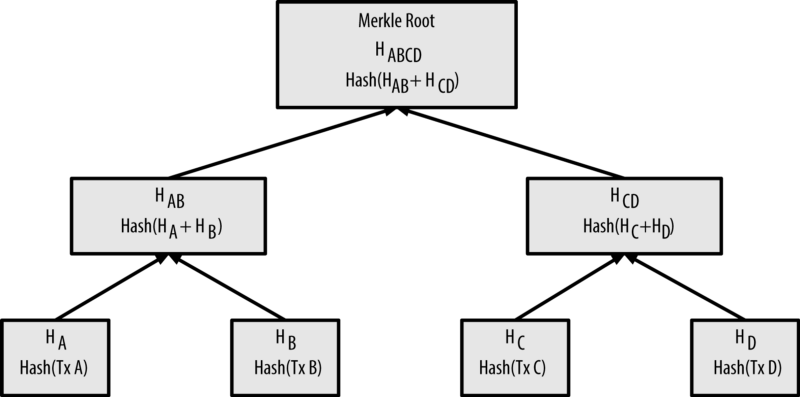
Transactions are bundled together and written to a block in the form of a merkle tree. Starting at the bottom, we have all of the transactions in a block and each is hashed with the SHA-256 algorithm. Then, two of those resulting hashes are hashed together, and so on up the tree until we reach a single root.
\
This merkle root is the foundation of how the Bitcoin blockchain maintains perpetual data integrity. This single merkle root is the unique "summary" of all of the transactions contained in this block. If even one byte of data in any of these transactions was changed, the merkle root would be completely different, rendering a block invalid.
Since this violates the rules of the Bitcoin protocol, a node would catch this change and reject that block as invalid.
Next is the block header, which is made of 6 components:
* Bitcoin software version number
* Block timestamp
* The merkle root of this block's transactions
* The hash of the previous block
* A nonce
* The target
By containing the hash of the previous block in every block header, we can create an immutable chain of blocks and an ongoing ledger of every transaction that has ever occurred. This is where we get the term blockchain.
Nonce and target are two components that are critical to the mining process, and we'll cover them below when we dive deeper into mining.
---
# Agent Instructions
This documentation is published with GitBook. GitBook is the documentation platform designed so that both humans and AI agents can read, navigate, and reason over technical content effectively. Learn more at gitbook.com.
## Querying This Documentation
If you need additional information that is not directly available in this page, you can query the documentation dynamically by asking a question.
Perform an HTTP GET request on the current page URL with the `ask` query parameter, and the optional `goal` query parameter:
```
GET https://docs.stacks.co/tutorials/bitcoin-primer/how-bitcoin-works/blocks.md?ask=&goal=
```
`ask` is the immediate question: it should be specific, self-contained, and written in natural language.
`goal` is optional and describes the broader end goal you are ultimately trying to accomplish on behalf of the user. GitBook uses it to tailor the answer towards what is most useful for that goal.
The response will contain a direct answer to the question and relevant excerpts and sources from the documentation.
Use this mechanism when the answer is not explicitly present in the current page, you need clarification or additional context, or you want to retrieve related documentation sections.