> For the complete documentation index, see [llms.txt](https://docs.stacks.co/llms.txt). Markdown versions of documentation pages are available by appending `.md` to page URLs; this page is available as [Markdown](https://docs.stacks.co/tutorials/bitcoin-primer/why-build-on-bitcoin/energy-usage.md).
# Energy Usage
One of the most common arguments for why proof of stake is a superior system to proof of work is the concept of energy usage.
This is a vast, complex, nuanced topic that deserves a serious study of its own. The TL;DR version is that the solution is not nearly as simple as many people would make it seem.
Usually, you hear some argument along these lines:
"We all know that consuming too much energy is a bad thing, and if we could have a system that uses 99.9% less energy than proof of work while maintaining all of the security benefits, why wouldn't we do that?"
Let's look at each premise, both explicit and implicit, contained in this line of reasoning piece by piece because while the logic of this thought process makes sense, every single premise is flawed.
"Bitcoin Uses Too Much Energy"
This statement is just a rephrasing of what the person stating it believes: "I don't think Bitcoin is valuable enough compared to the amount of energy it uses."
This is a better, more intellectually honest place to start, and gives us a solid place to start examining if this is a logical position to hold.
For context, nobody thinks that energy consumption is bad on its own, it's just whether or not the value being produced as a result of that energy consumption is worth it or not.
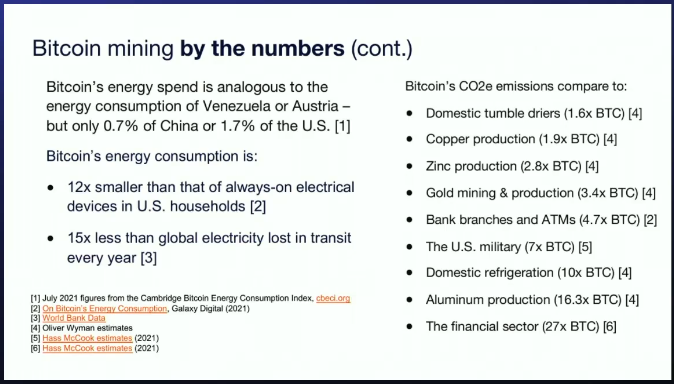
For example, here is a partial list of things that use more energy than the entire Bitcoin network and how they compare.
If we want to go with the argument that Bitcoin uses too much energy, we also need to admit that everything on this list should also not exist since it uses too much energy.
But we don't do that because we understand these things have value that is created as a result of energy usage.
So, then the question becomes, is Bitcoin's energy usage worth it?
Even if Bitcoin becomes wildly successful with trillions of dollars of utility and billions of users, it might rise to consume more than 1% of global energy usage. But is it that much when we consider the fact that it would be running the entire decentralized economy at that point, and all of the benefits that come with that?
Don't forget that part of this argument is assuming that proof of stake can replicate Bitcoin's security and decentralization, we'll get to that soon.
in addition to this, Bitcoin is a very large driver of unique energy sources that would otherwise be completely wasted.
This is a rabbit hole of a topic too deep for this course, so we recommend any interested developers read the work of [Lyn Alden](https://x.com/LynAldenContact), [Nic Carter](https://x.com/nic__carter), [Troy Cross](https://x.com/thetrocro), or [C. Jason Maier](https://www.bitcoinprogressive.com/) to get a better handle on the nuances of the energy debate.
Here is an excellent piece to get you started. I took a lot of the information contained here from this source.
[Bitcoin's Energy Usage Isn't a Problem](https://www.lynalden.com/bitcoin-energy/) - Lyn Alden
Let's quickly address the idea of "cost per transaction." This comparison is made by advocates of other chains constantly, that so-and-so chain is energy efficient and each transaction only uses as much electricity as sending an email or something like that.
This is a flawed way to think about Bitcoin's energy usage and is comparing apples to oranges.
Bitcoin's energy usage comes from miners creating new blocks and earning the new block subsidy, and the network uses largely the same amount of energy regardless of how many transactions are contained in a block.
While it is true that Bitcoin's energy usage scales with how many users are on the network, thinking about the cost per transaction is nonsensical.
Covering the rest of the implicit assumptions requires looking at things from an economic and technological angle, so let's do that now.
---
# Agent Instructions
This documentation is published with GitBook. GitBook is the documentation platform designed so that both humans and AI agents can read, navigate, and reason over technical content effectively. Learn more at gitbook.com.
## Querying This Documentation
If you need additional information that is not directly available in this page, you can query the documentation by asking a question.
Perform an HTTP GET request on the following URL with the `ask` and `goal` query parameters:
```
GET https://docs.stacks.co/tutorials/bitcoin-primer/why-build-on-bitcoin/energy-usage.md?ask=&goal=
```
`ask` is the immediate question: it should be specific, self-contained, and written in natural language.
`goal` is what the user is ultimately trying to achieve, the reason they need the answer. Sharing it helps GitBook give you a better, more relevant answer. A goal is most helpful when it describes the outcome the user wants rather than restating the question. For example, with `ask=how do I create an API token`, a goal like `automate deployments from our CI pipeline` lets GitBook tailor the answer to that use case.
The response will contain a direct answer to the question and relevant excerpts and sources from the documentation.
Use this mechanism when the answer is not explicitly present in the current page, you need clarification or additional context, or you want to retrieve related documentation sections.